
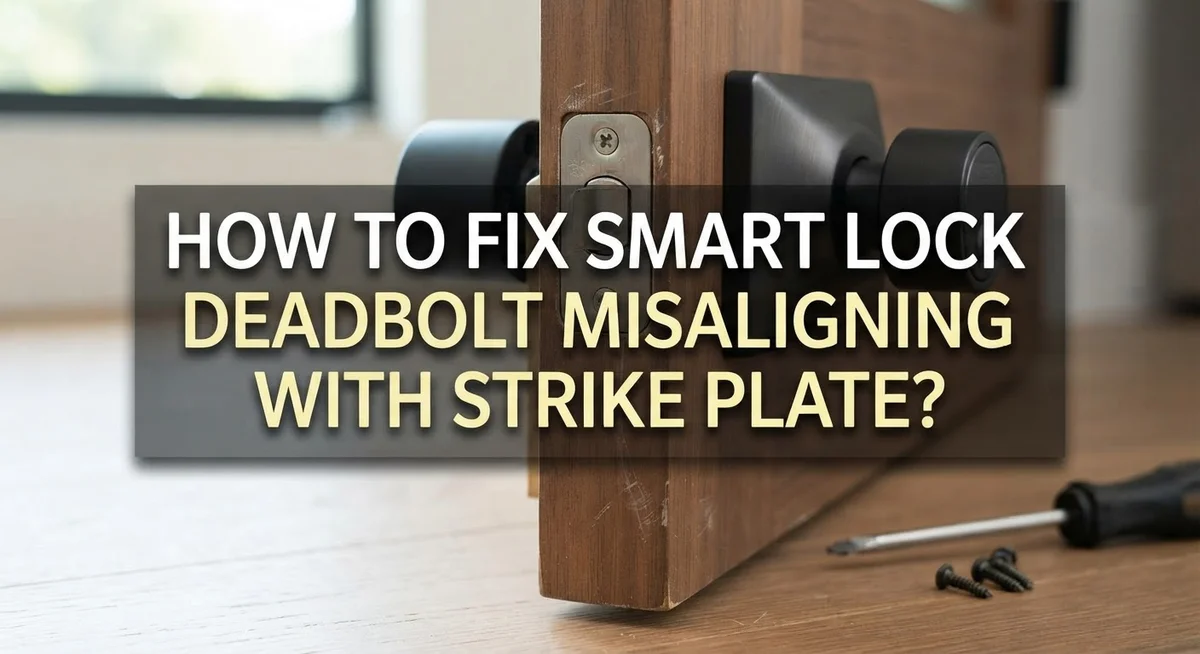
How To Fix Smart Lock Deadbolt Misaligning With Strike Plate?
Does your smart lock deadbolt refuse to slide into the strike plate smoothly? You are not alone.
This is one of the most common smart lock problems homeowners face. The good news? You can usually fix it yourself without calling a locksmith.
Misalignment happens when your deadbolt and strike plate stop lining up properly. This creates that annoying grinding or sticking feeling when you lock your door.
Several culprits cause this issue. Loose hinges are often the main offender. A tilted door frame or natural door settling can also throw things out of sync.
In this guide, we will walk you through simple diagnosis steps first. You will learn how to identify whether your misalignment is vertical, horizontal, or both.
In a Nutshell
- Check hinges first. Loose hinges are the top cause of deadbolt misalignment. Tighten them before you touch anything else.
- Find the misalignment type. Use a chalk or lipstick trick to see if the bolt hits too high, too low, or off to the side.
- Adjust the strike plate. Loosen its screws and shift it slightly to match the bolt path. Small moves work best.
- Pull the frame with longer screws. Swap top frame screws for 3 inch screws. This draws the frame back into proper alignment.
- Widen the hole if needed. A drill can enlarge the strike plate opening just enough for smooth bolt entry.
- Smooth the door edge. Sand or plane it lightly if it sticks or drags against the frame.
- Test after every change. Close the door and engage the lock each time you adjust something. This helps you avoid overcorrecting.
Understanding Why Smart Lock Deadbolts Misalign
Your smart lock deadbolt misaligns when the bolt and strike plate no longer line up. This happens for specific reasons you can identify and fix yourself.
Loose hinges are the primary culprit behind misalignment. Over time, hinges work themselves loose from daily door use. When hinges loosen, your entire door shifts slightly. The deadbolt then sits in a different position relative to the strike plate. Check each hinge by tightening its screws with a screwdriver.
Door frame settling causes misalignment too. Houses naturally settle as they age. This settling tilts or shifts the frame, pushing it out of square. Your deadbolt was perfectly aligned when installed, but the frame moved. The bolt now hits the strike plate at an angle instead of straight on.
Tilted door frames happen from foundation issues or improper installation. If your house sits on uneven ground, one side may settle more than the other. This creates a twisted frame where the top and bottom don’t align vertically. Your deadbolt struggles to enter the strike plate opening.
Humidity and temperature changes make wood swell and shrink. Doors expand in humid conditions and contract when dry. This movement can shift both the door and frame slightly, breaking alignment.
Worn strike plates develop enlarged holes from repeated bolt contact. The bolt slides around inside the opening instead of fitting snugly. This creates play that feels like misalignment even when everything else is correct.
Understanding which cause affects your lock helps you apply the right fix. Start by checking hinges first, then diagnose whether misalignment runs vertically, horizontally, or both directions. This information guides your repair strategy effectively.
Diagnosing the Type and Direction of Misalignment
When your smart lock deadbolt refuses to engage smoothly, you need to identify exactly what type of misalignment you have. This tells you which fix will work best.
Start by closing your door and engaging the deadbolt. Pay attention to where the bolt meets resistance. Does it hit the strike plate too high? Too low? Does it slide off to the left or right? This observation matters because vertical and horizontal misalignments need different solutions.
Use the chalk or lipstick method to see the exact contact point. Apply chalk to your bolt, then close the door gently without locking it. The chalk mark shows you precisely where the bolt touches the strike plate. This visual proof eliminates guesswork.
Check if the misalignment is vertical first. If the bolt hits above or below the opening, your door frame likely tilted or your hinges loosened. Vertical shifts are usually bigger problems than horizontal ones.
Horizontal misalignment means the bolt drifts left or right. This often happens when hinges loosen on one side, causing the door to hang unevenly.
Combined misalignment means the bolt misses in multiple directions. This typically points to significant frame settling or multiple loose hinges.
Once you know your misalignment type, test the door frame itself. Press firmly on different spots around the frame. Does it feel solid or does it flex? A flexible frame needs the long screw method. A solid frame might just need strike plate adjustment.
Document your findings before making any repairs. Take a photo or write down whether your misalignment is high, low, left, right, or mixed. This record helps you track whether your fixes actually work and prevents you from making unnecessary adjustments.
Checking and Tightening Door Hinges
Loose hinges are the most common cause of smart lock deadbolt misalignment. Your door hinges hold the entire door in place, so when they loosen, the door shifts out of position. This shift throws off the bolt and strike plate alignment.
Start by locating all hinges on your door. Most doors have three hinges: one near the top, one in the middle, and one near the bottom. Use a screwdriver to check each hinge screw. Turn clockwise to tighten.
Pay special attention to the top hinge. This hinge bears most of your door’s weight. A loose top hinge causes the door to sag or tilt, creating vertical misalignment where the bolt sits too low.
Tighten screws firmly but don’t over tighten. You want a snug fit without stripping the screw holes. If screw holes are stripped and won’t hold, remove the hinge and fill the hole with wooden toothpicks and wood filler. Let it dry, then reinstall the hinge with a fresh screw.
After tightening all hinges, close your door and engage the deadbolt. Does it slide in smoothly now? If yes, your problem is solved. If no, the hinge adjustment helped but other issues remain.
Check the hinges again after a few days. Loose hinges sometimes tighten themselves as the door settles. If they loosen again quickly, the hinge screws may be too short or the holes may need reinforcement.
Tight hinges form the foundation for proper deadbolt alignment. Always check hinges first before trying other fixes. This simple step solves most misalignment problems without requiring additional adjustments.
Step-by-Step: Adjusting the Strike Plate for Proper Alignment
Start by loosening the strike plate screws slightly. Don’t remove them completely. You need just enough slack to shift the plate position.
Close your door and engage the deadbolt. Mark where the bolt contacts the strike plate using chalk or lipstick. This shows you exactly which direction the plate needs to move.
For vertical misalignment, the bolt hits above or below the opening. Loosen the strike plate screws and slide the plate up or down accordingly. Make small adjustments. Test after each shift to avoid overshooting.
For horizontal misalignment, the bolt drifts left or right. Loosen the screws and slide the plate sideways. Again, move it gradually and test frequently.
Once the bolt aligns with the opening, tighten the screws firmly. Don’t over tighten or you’ll crack the wood around the screw holes.
If the strike plate hole is now too large or damaged from previous misalignment, you have options. You can enlarge the opening slightly with a drill to accommodate the bolt. Work slowly and check fit often.
For more stubborn cases, replace the top frame screws with longer 3 inch screws. These reach deeper into the frame and can pull it back into proper alignment. This addresses frame settling issues that simple plate adjustment can’t fix.
Test the deadbolt multiple times after adjustment. The bolt should slide smoothly into the opening without resistance. The door should close and lock without sticking or binding.
If misalignment returns within days, the issue likely stems from loose hinges or frame problems rather than strike plate position. Return to checking hinge tightness and frame integrity.
Using the Long-Screw Method to Correct Frame Alignment
The long screw method fixes misalignment by pulling your door frame into proper position. This technique works best when your frame has shifted or settled over time, causing the bolt to miss the strike plate opening.
Here’s how the method works. Your door frame’s top section often shifts slightly, throwing off deadbolt alignment. By replacing the top frame screws with longer 3 inch screws, you create tension that pulls the frame back into square. This realigns everything without forcing the bolt.
Start by identifying which screws need replacement. Locate the screws that attach your door frame to the wall studs, especially the top ones. These are your targets. Remove one screw at a time and replace it with a longer screw of the same diameter and thread type.
Turn each new screw slowly and steadily. You’ll feel resistance as the longer screw pulls the frame into alignment. Don’t force it or over tighten, as this can crack the frame or damage the door. Make small adjustments with each screw.
After installing all longer screws, close your door and engage the deadbolt. Test it several times to confirm smooth operation. The bolt should slide into the strike plate opening without resistance or binding.
Important tip: Make incremental adjustments rather than tightening everything at once. This prevents uneven stress on your frame. If you notice the door becoming harder to close or hinges straining, you’ve tightened too much. Back off slightly and retest.
This method often solves persistent misalignment issues that simple strike plate adjustments cannot fix. It addresses the root problem of frame movement rather than just compensating for it.
Enlarging the Strike Plate Opening and Sanding the Door Edge
When your strike plate opening doesn’t match your bolt’s path, enlarging the hole becomes necessary. This fix works best after you’ve confirmed the misalignment direction and adjusted what you can with the strike plate itself.
Start by removing the strike plate completely. Use a drill with a bit slightly larger than your current bolt diameter. Mark the new opening size on the plate before drilling. Make slow, steady passes to avoid cracking the metal. Test fit the plate back onto the door frame to ensure the bolt passes through smoothly.
Sand the door edge if the bolt catches on wood rather than the plate opening. Use medium grit sandpaper and work in the direction of the wood grain. Remove material gradually, testing after each pass. You only need to sand enough to create clearance for the bolt.
For doors that stick slightly, plane the latch edge carefully. This removes thin layers of wood without weakening the door structure. Work from the top and bottom edges toward the center to prevent splintering.
After enlarging the strike plate opening, reinstall it and test your deadbolt several times. The bolt should slide into the opening without resistance. If you still feel binding, sand a bit more or drill the opening slightly larger.
This method prevents forcing your deadbolt, which can damage the lock mechanism over time. Gentle adjustments protect your smart lock’s internal components. If enlarging the strike plate doesn’t solve the problem completely, the issue likely involves frame settling or hinge problems that need separate attention.
Testing and Fine-Tuning Your Smart Lock After Adjustments
After you make adjustments to your smart lock deadbolt, testing becomes your most important step. You need to verify that everything works smoothly before considering the job complete.
Start by closing your door gently and engaging the deadbolt several times. Listen for any grinding sounds or resistance. The bolt should slide into the strike plate opening with minimal effort. If you hear grinding or feel resistance, stop and reassess your adjustments.
Mark the bolt position with chalk or lipstick to see exactly where it contacts the strike plate. Open the door and examine the mark carefully. The bolt should leave a clear impression centered within the strike plate opening. If the mark appears off center, you know additional adjustment is needed.
Test the lock from both sides of the door. Engage it from inside, then check from outside. Your smart lock should operate smoothly from both directions without any hesitation or clicking sounds.
Make small adjustments rather than large ones. Tighten one screw slightly, test the deadbolt, then move to the next adjustment. This approach helps you avoid over correcting the problem.
Pay attention to how your door closes. It should shut smoothly without catching or binding. If your door seems to stick slightly during closing, the frame may still be misaligned.
Leave your smart lock engaged for several hours, then test it again. Sometimes misalignment becomes obvious only after the lock sits in the engaged position for a while. This waiting period reveals whether your adjustments truly solved the problem or if deeper frame issues remain.
Document your testing results. Note which adjustments worked and which didn’t. This information helps if you need to make additional corrections later.
Common Mistakes That Make Misalignment Worse
Many people make mistakes that make their deadbolt misalignment worse instead of better. Understanding these errors helps you avoid costly damage to your lock system.
Ignoring loose hinges is the biggest mistake. Most people focus on the strike plate when the real problem sits on the door itself. Loose hinges cause your door to shift and tilt over time. Check all three hinges before adjusting anything else. Tighten each hinge screw firmly, but don’t strip them by over tightening.
Another common error involves forcing the deadbolt when it sticks. Pushing hard on a misaligned bolt damages the lock mechanism inside. The bolt should slide smoothly into the strike plate opening. If you feel resistance, stop immediately and diagnose the problem instead.
People often adjust the strike plate without identifying which direction the bolt misaligns. You need to know if the problem is vertical, horizontal, or both. Use chalk or lipstick to mark where your bolt actually touches. This simple step prevents blind adjustments that waste your time.
Making large adjustments all at once creates new problems. You might over correct and create a different misalignment. Small, incremental changes let you see exactly how each adjustment affects your deadbolt.
Some people replace the entire strike plate when simple repositioning would work. The strike plate usually just needs to move slightly up, down, left, or right. Try loosening screws and shifting it before buying replacement parts.
Finally, testing after each small change matters more than rushing through all fixes at once. Your patience prevents frustration and protects your smart lock from unnecessary stress.
Final Thoughts
Fixing a misaligned smart lock deadbolt does not need to feel hard. Most problems start with loose hinges or a small shift in your door frame.
Once you diagnose the exact cause, the fix usually takes only a few simple steps.
Start by checking your hinges first. Tight hinges solve many alignment problems before you touch the strike plate at all.
If hinges are fine, look at the strike plate position. Small screw adjustments often correct vertical or horizontal gaps.
For bigger frame issues, longer screws pull the frame back into shape. This method works well when the door itself has settled over time.
Patience makes a real difference here. Rushing through adjustments often creates new problems instead of solving old ones.
Always test your deadbolt after each change you make. This habit helps you catch issues early before they get worse.
Remember that smart locks rely on precise alignment to work properly. Even small gaps can affect how the bolt extends and retracts.
If your lock still struggles after basic fixes, check for deeper frame damage. Warped wood or shifted frames sometimes need more attention.
Simple tools like chalk or lipstick help you see exactly where your bolt contacts the plate. This small trick saves time and prevents guesswork.
Fixing alignment issues protects your lock’s motor and internal parts. A well aligned deadbolt lasts longer and works smoother every day.
With steady effort and the right diagnosis, most smart lock alignment issues become easy to solve. Take your time, follow each step, and your lock should feel reliable again soon.
Frequently Asked Questions
Why does my smart lock deadbolt keep misaligning after I fix it?
Misalignment often returns because you didn’t address the root cause. Loose hinges are the main culprit. Your door shifts slightly over time, pulling the bolt out of position with it. Always check hinge tightness first before adjusting the strike plate.
Door frames also settle naturally. Wood shifts with temperature and humidity changes. This causes the frame to tilt gradually. If your fix doesn’t last, the frame itself may need adjustment with longer screws.
Can I fix misalignment without removing the strike plate?
Yes, you can make small adjustments without full removal. Loosen the strike plate screws slightly, then nudge the plate in the direction your bolt needs to go. Tighten one screw at a time while testing.
This works best for minor misalignment. If your bolt misses the opening by more than a quarter inch, you’ll need to remove the plate completely. This gives you better control over repositioning.
What’s the chalk or lipstick method?
This simple trick shows exactly where your bolt contacts the strike plate. Close your door and engage the deadbolt normally. Mark the bolt tip with chalk or lipstick, then open the door and look at the strike plate opening.
The mark shows whether your bolt hits above, below, left, or right of the opening. This tells you which direction to adjust the strike plate. It saves time and prevents guessing.
Should I replace my strike plate if it’s damaged?
Not always. Small dents or scratches don’t affect function. However, if the bolt opening is enlarged or the plate is bent, replacement makes sense. You can also enlarge the opening carefully with a drill if the bolt barely misses the hole.
Before replacing anything, try repositioning first. Most misalignment fixes cost nothing but a few minutes of your time.
Hi, I’m Minnie Cole, the creator of The Output Lab — a space where I share my passion for all things tech. I spend my days exploring the latest gadgets, devices, and electronics on Amazon, putting them through real-world testing so you don’t have to.